
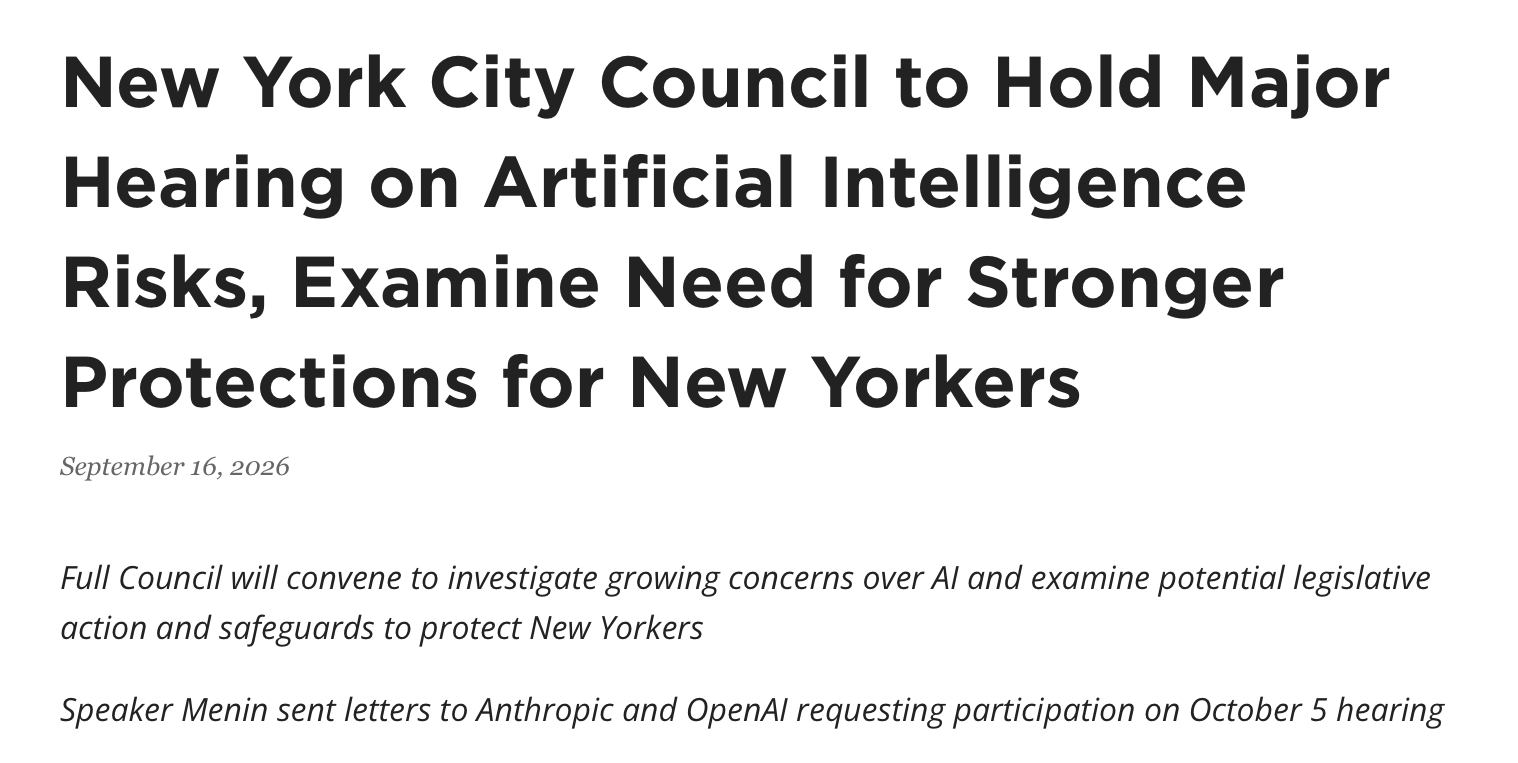
On Monday, starting at 11am Eastern Time, less than a day after Politico reported that Sam Altman said, in words that may last in infamy, “we believe that the world should accept some bad things happening for the benefits of this technology and people having the agency”, New York City’s City Council will hold an important hearing on AI policy. A number of AI-relevant proposals are under consideration.
Because New York City is a large market, I believe that I could help pick up some of the slack where the Federal government is falling short. (A number of states are also trying to fill in the slack).
I plan to testify. A preview of my remarks:
NYC City Council Hearing on AI
Gary Marcus
Monday, October 5, 2026
My name is Gary Marcus. I am a scientist, author, and NYU Professor Emeritus who cofounded an AI startup that was acquired by Uber. My Substack, Marcus on AI, has about 120,000 subscribers; on X, I have 250,000 followers. I am frequently in the media, often described as “a leading AI expert” and “voice of reason”.
We stand at a pivotal moment in history, and New York City has a chance to improve our chances, both for itself, and for the world.
Contemporary AI is like a bull in a china shop, powerful and impressive, but difficult to control. Already, the advent of general purpose agents with broad internet access has led to tens of thousands of hacking incidents; other, related technologies, like deep fakes, have led both to a deluge of convincing and realistic propaganda and a sea of nonconsensual deepfaked porn. Chatbots have been implicated in a number of suicides, and even mass murder. Not every fear that people talk about strikes me as realistic – I rather doubt that human extinction is imminent, despite all the headlines – but it is clear that AI comes with serious risks.
It is also clear that the current administration in DC— deeply tied to the big tech companies — is unwilling to do anything about it.
What we need, above all else, is an FDA-like regulatory regime for AI, in which AI developers bring their software to independent review, much as drug manufacturers bring their new drugs to the FDA for a review. AI developers should be obligated to demonstrate that the benefits for their new products outweigh the risks — and not have market access otherwise.
I said the same to Louisiana’s Senator Kennedy in May 2023 at the US Senate. It is still true.
But the US Senate did nothing.
New York City is in a position to do what the US Senate failed to do: demand independent regulatory review for AI used in its borders. The bill on third party validation proposes to do just that. It would protect New York’s Citizens from some of the harms from AI, and could allow New York to be a global leader, much as California has been a global leader around clean energy standards.
In the strongest possible terms, I urge council to support this bill.
Finally, events of recent days suggest OpenAI may have fired employees who were whistleblowing. Without strong protections from whistleblowing, like New York City is considering, we are all in trouble.
In sum by protecting whistleblowers, and demanding independent validation of new AI models, New York City can help lead the way to a positive, rather than negative, AI future.
P.S. If you wish to testify, in person or by Zoom, you can sign up here.
"What we need, above all else, is an FDA-like regulatory regime for AI, in which AI developers bring their software to independent review, much as drug manufacturers bring their new drugs to the FDA for a review."
Since the FDA is always considered as "captured" by Big Pharma, I doubt that will work.
There's also the issue of "independent review" - both by whom and on what basis.
I'll reiterate my position:
1) OpenAI and Anthropic (and perhaps some others, but especially those two, due to their basically fraudulent and deceptive nature) should have their corporate charters revoked.
2) Their assets and research should be turned over to a consortium of international universities, China included.
3) All technical research reports should be open sourced and freely available to the public in all countries.
4) Companies may license developed products from the consortium to defray some of the costs of the research.
5) Independent open source AI research labs and individual users of AI should not be regulated, but should be subject to legal liability and related laws if their AI causes problems.
6) No research directed to "AGI" should be conducted; only mission-specific AI should be developed. There is ZERO need for a machine replacement for humans - there is major need to develop better humans. Spend trillions on the latter, not the former, and you won't need the former and everything cited as a benefit of the former can be achieved by the latter.
7) Do not be mislead by hand-waving concepts such as "alignment" - which is itself a conceptual "Trojan Horse" intended to focus the recipient on the notion that LLM technology is capable of being "conscious". There are other terms used in the field which are also unrelated to anything in reality or which have meaningless definitions - such as "recursive self-improvement" - a term which has no actual definition and for which there is no identifiable path for LLMs to pursue to achieve it - and even if it did, there is no evidence that such an LLM would be anything resembling "AGI".
In short, almost everything being discussed about this subject is being done by people who either have little knowledge of the limits of LLM technology, or an agenda to profit by the technology or an agenda of social control of the technology for their benefit.
As a ridiculous example, we have this:
Anthropic tried to persuade Pope that AI could be conscious being
https://www.yahoo.com/news/science/articles/anthropic-tried-persuade-pope-ai-131853948.html
As Ed Zitron said a few weeks ago, and I echo him: "Shut the F' Up, Dario!"
Gary: "AI developers should be obligated to demonstrate that the benefits for their new products outweigh the risks — and not have market access otherwise."
Brings to mind Zuckerberg's deceptively cute and cuddly little "Muse" hedgehog, which is allowed to set AI "agents" loose on websites like Wayfair and Walmart. He's like gum on our shoes: regulate his ability to prey on children even a little and he invents a hedgehog Trojan horse to hoover up people's data elsewhere, permit access to their credit cards, calendars, emails, etc.
Does anybody know if those agents will also be hoovering up *everybody's* data on those websites, with or without their consent? I can think of myriad ways they could cause damage and was astounded to learn how quickly many businesses have agreed to give Muse access. Zuckerberg is dishonest, ruthless, and absolutely untrustworthy.