
Greetings from New Delhi.
In an emailed newsletter, Laura Bratton at The Information has reported on a new study (direct link not available):
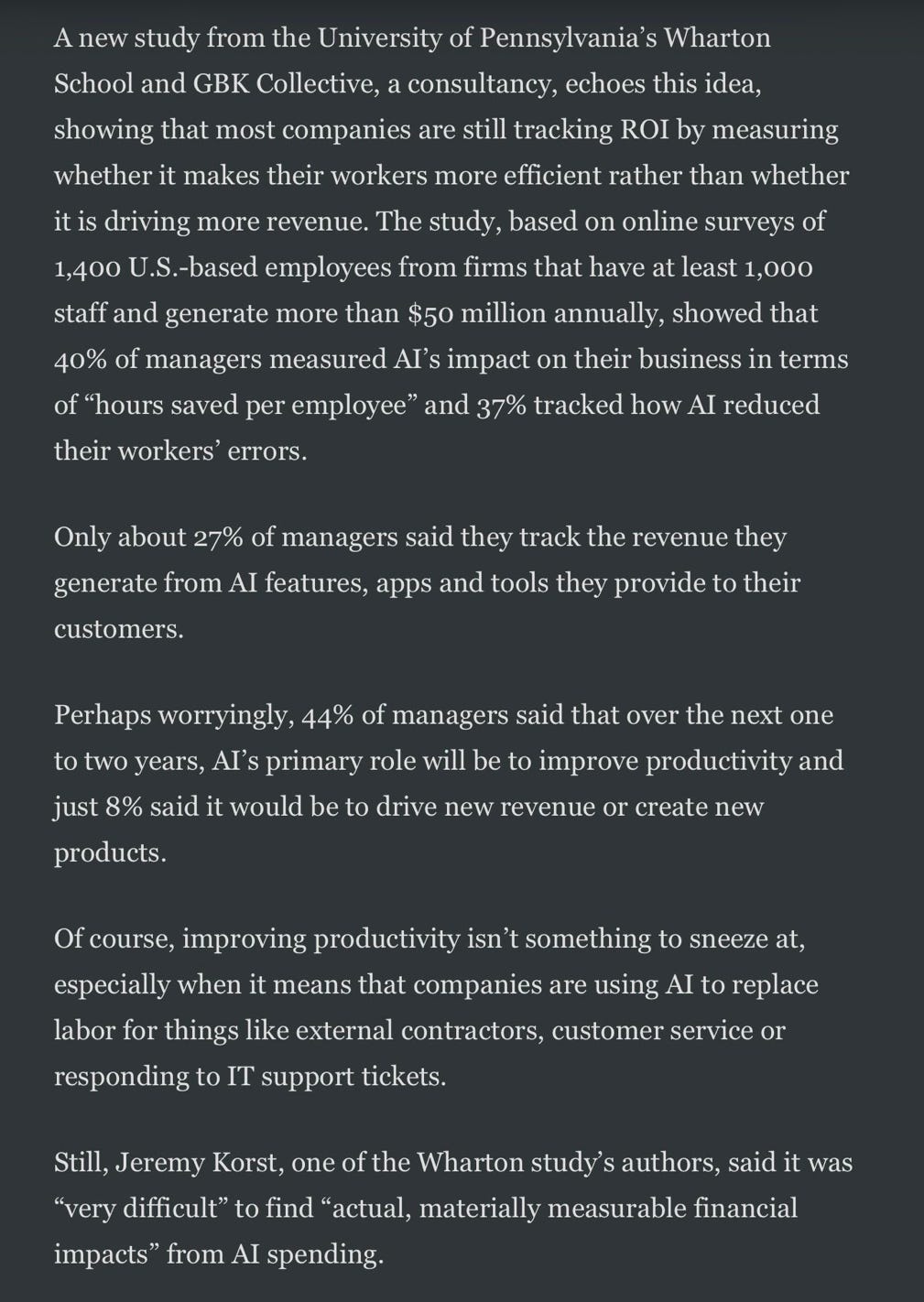
Anybody remember back in early 2023, when people imagined that ChatGPT was going to 10x every employee’s productivity and radically boost the GDP’s of entire countries?
So far, there’s zero evidence of anything like that happening at scale.
The juxtaposition between the minimal documentable ROI and the trillions of dollars invested in this technology remains perverse and often baffling.
P.S. In other news, early generative AI darling Character.AI has filed for bankruptcy, and Coreweave bonds have reached 15%, suggesting that credit markets have had enough.

Roger@rdd147
$CRWV bonds blow up to 15.1% in a day as company faces existential bankruptcy risks.


Roger @rdd147
$CRWV bonds break 14%, hitting a high of 14.15% today.
Bonds begin appearing in CCC CLOs; likely have credit downgrade incoming to CCC
1:47 PM · Oct 13, 2026 · 121K Views
42 Replies · 99 Reposts · 812 Likes
P.P.S. This is insane.

.
Or -- hear me out -- they're taking up smoking because they're convinced the Robot Rapture is imminent, so might as well smoke 'em if you got 'em. Lung cancer and COPD won't kick in for years, and if you're listening to the signals coming out of the Anthropic faithful we've got months, at best.
I agree that MOST companies have yet to see ROI from AI, and the reason is, in my practitioner opinion, because of their approach.
They start with the technology, instead of starting with the outcome they want to achieve. (As in, they throw AI at everything and hope it impacts the bottom line... It does, but not how they hoped it would - it often increases their costs)
As boring as it sounds, when I delivered revenue uplift or cost savings with AI, I picked the use case, mapped the old way of doing things (workflow, process), identified the bottleneck, and THEN selected the capability and technology to address the bottleneck.
Sometimes the technology was old school ML or a rules engine. Fewer times, it was LLMs. The point was, I was familiar with the use case and had a menu of capabilities and technologies to choose from.
And, importantly, once this workflow would be implemented with that technology, I would go back and reevaluate it to see what the new bottleneck is, and address that with a similar evaluation of technology options. It's an iterative process.
All while tracking the progress to the desired outcome with clearly defined metrics.
Surprise: most of the solutions didn't use Claude Opus, OpenAI Sol or anything even remotely similar. And the solution architecture was such that it was tailored for these particular use cases.