OpenAI’s “Code Red”
Maybe people should have seen this coming?

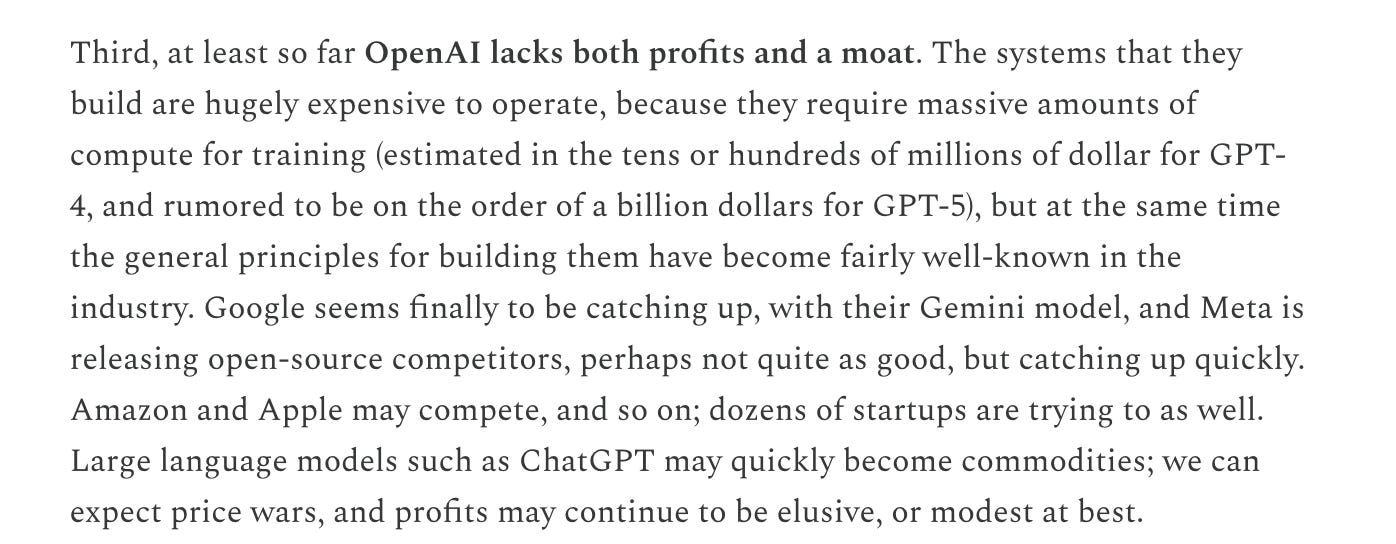
The words above mostly could have been written earlier today, but they are actually from this Substack, nearly two years ago, in an essay called OpenAI’s Got 9.9 Problems, and Twitch Ain’t One. The basic thesis then was that although OpenAI was then the darling of AI, things could change. Things took longer to unravel than I thought they would, but OpenAI’s unraveling has begun.
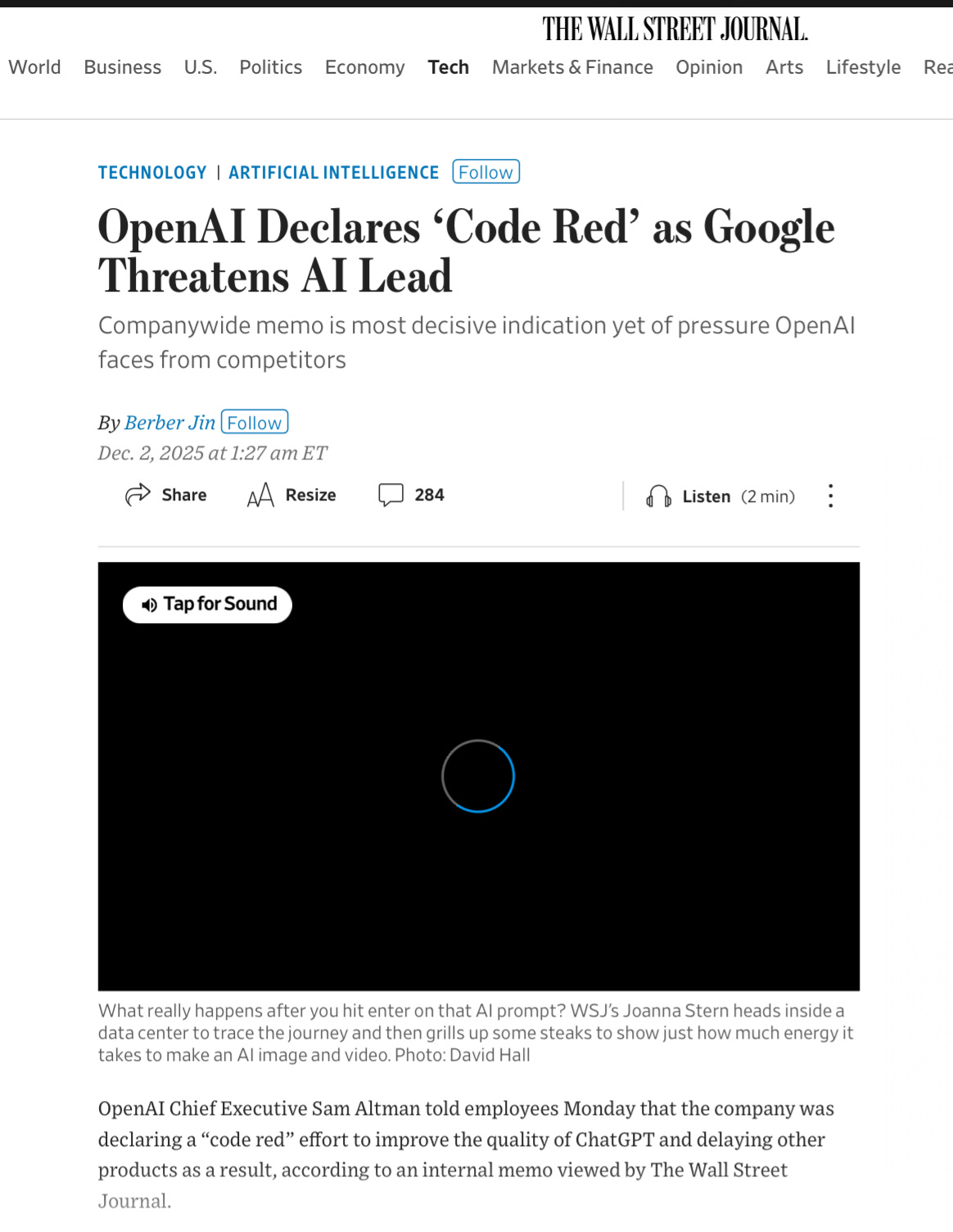
As The Wall Street Journal reports, the company has just declared a Code Red; they are terrified that Google’s new model has eclipsed them. By any reasonable measure OpenAI has clearly squandered the sizable lead they once had.
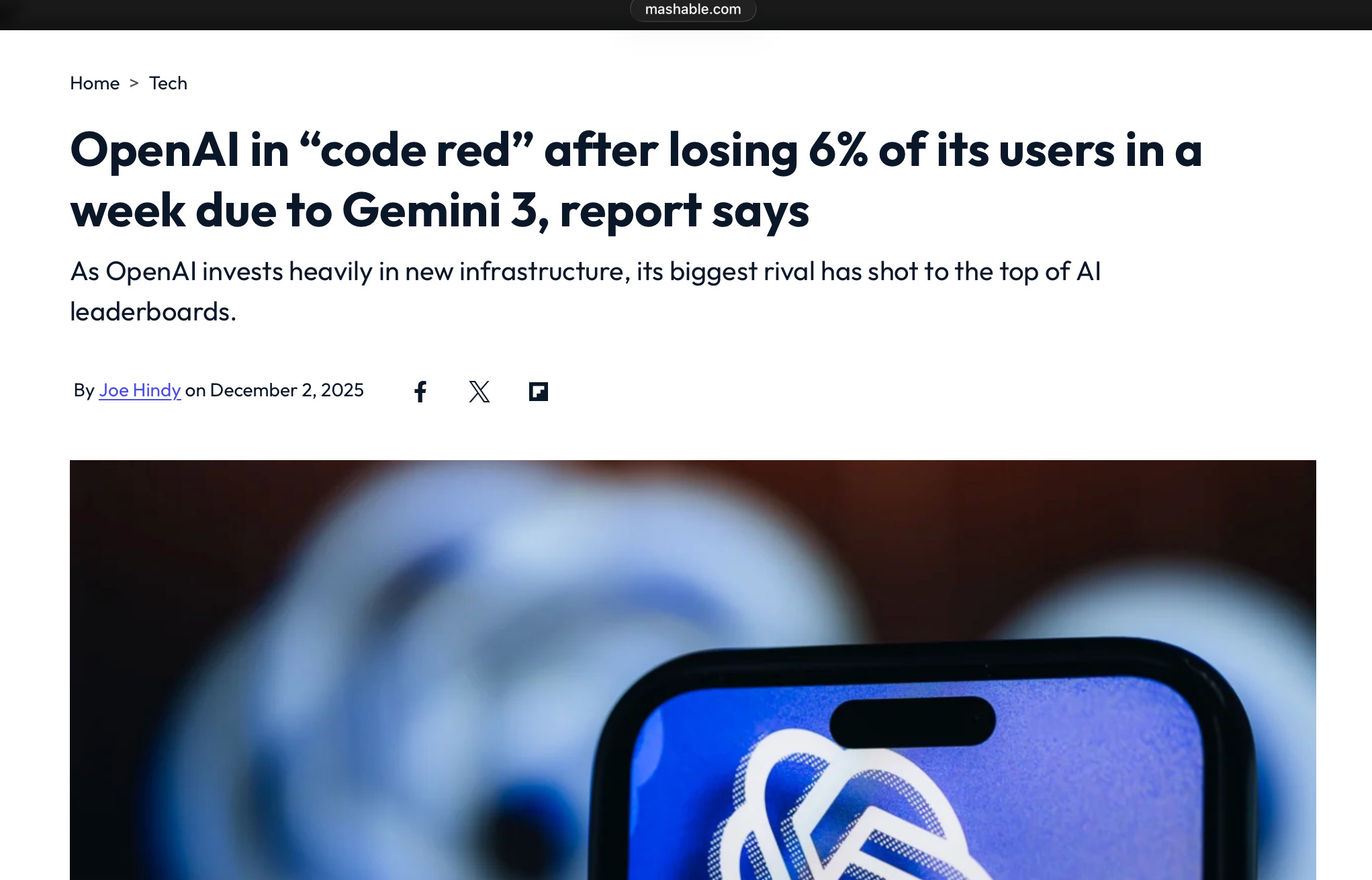
That code red may in stem part from a recent exodus of users:
The code red also comes on the heels of another recent internal memo in which Altman acknowledged that the company could “face some temporary economic headwinds”, and after the company’s CFO seemingly attempted to lay the groundwork for a potential AI industry bailout.
Altman’s complete non-answer to Brad Gerstner’s question at the beginning of November about the discrepancy between the company’s modest revenue and its enormous trillion dollar commitments is a further sign of how troubled the company is:
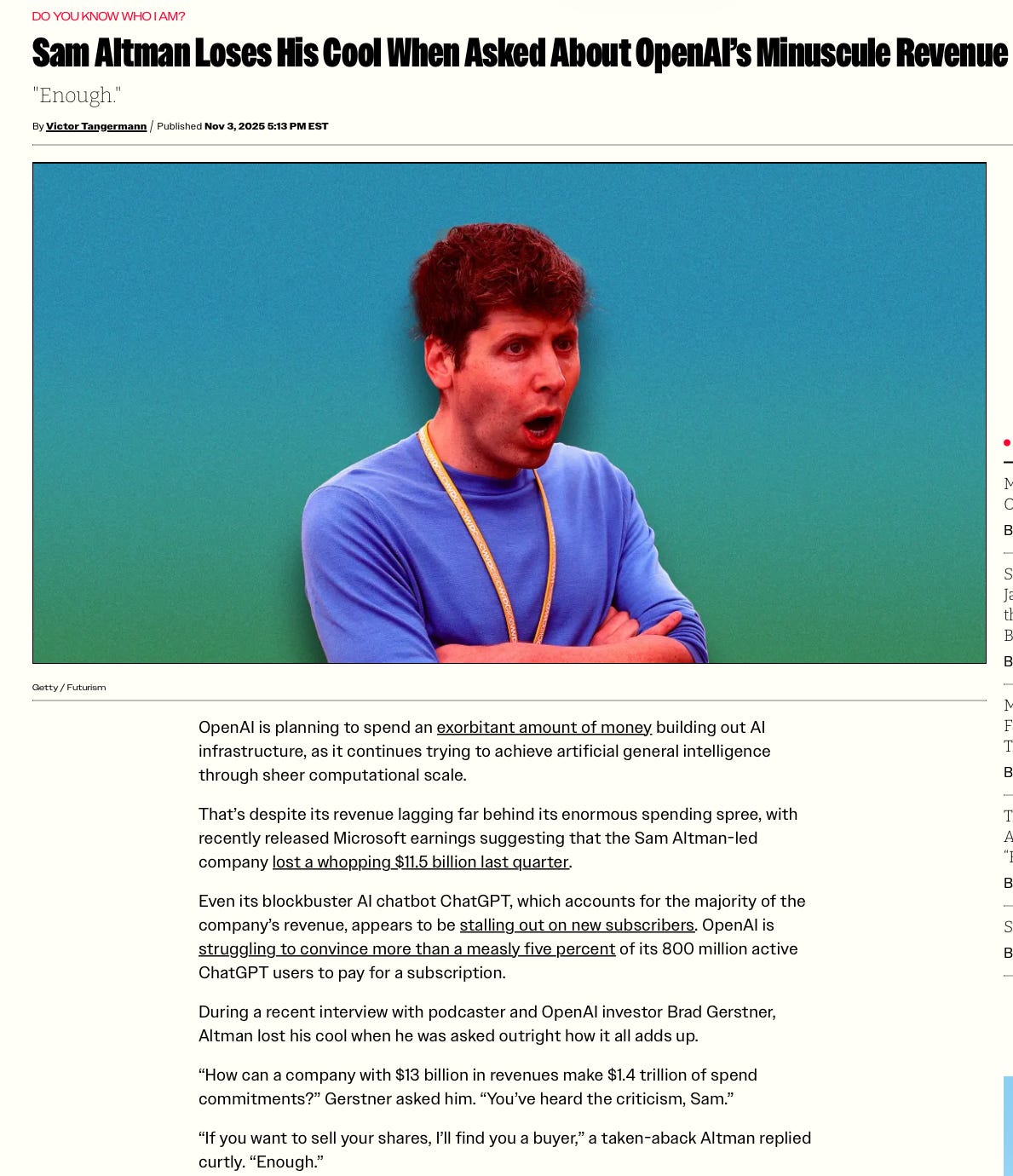
In short, OpenAI has lost their lead, and massively overextended themselves. Worse, they are burning billions of dollars of month.
Their war chest is impressive, but their burn rate is terrifying. My guess is that they have cumulatively raised on the order of $100 billion since they launched, perhaps more than any other company in history, but have already spent most of it, and likely don’t have much more than a year’s runway left.
Since they are losing money and can’t stand on their own two feet for long. That puts them at the mercy of investors. If things continue to deteriorate, raising the next round will be a lot harder than the last. Investors and banks will smell blood and sense risk and hence either sit out (which would spell the end of the company) or demand harsh terms. Few investors have the deep pockets OpenAI needs to stay afloat. If most or all opt out, OpenAI’s valuation could drop, perhaps precipitously, as happened with WeWork, which dropped rapidly from its peak of $47 billion to near-bankruptcy.
If OpenAI drops, Nvidia might well also drop. (As noted here earlier, Google has their own chips and less dependence on Nvidia). And of course many other companies are also in close relationship with OpenAI, with a lot of future orders from them on the books. These too might drop.
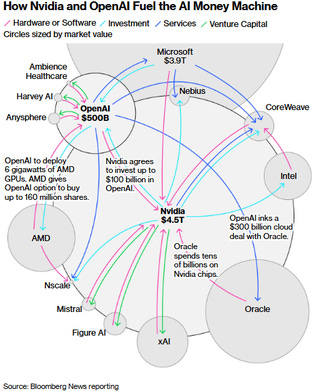
Pension funds like CalPERS that have invested in OpenAI also stand to take a sizable loss, if the company proves unable to maintain its original meteoric trajectory.
When WeWork fell, SoftBank (which happens to be the leading recent backer of OpenAI) took most of the hit. If OpenAI falls, SoftBank will hardly be alone in struggling to pick the pieces. In the worse case, the government might seriously consider a bailout a taxpayer expense.
Given how long the writing has been on the wall, I can only shake my head.
Since the tech can’t ever deliver on the promises made by the execs, the outcomes are either go the WeWork way or potentially get acquired by MSFT for few cents on a dollar. Inspired me to write this:
R.I.P. TechBro Era 2008–2025: The Inevitable GenAI Crash (Part 1)
https://srinipagidyala.substack.com/p/rip-techbro-era-20082025-the-inevitable
Wonder if this would’ve still happened if the Board had the intestinal fortitude to fire him and stay fired…