The month Generative AI lost its mojo
June is not over, and anything could still happen, but a lot already has.

“WeWork’s IPO fell apart.
I’ve been calling OpenAI the (possible) WeWork of AI for a long time.
I will not be surprised if their IPO plans fall apart, too”
News, mostly just from the last few days:
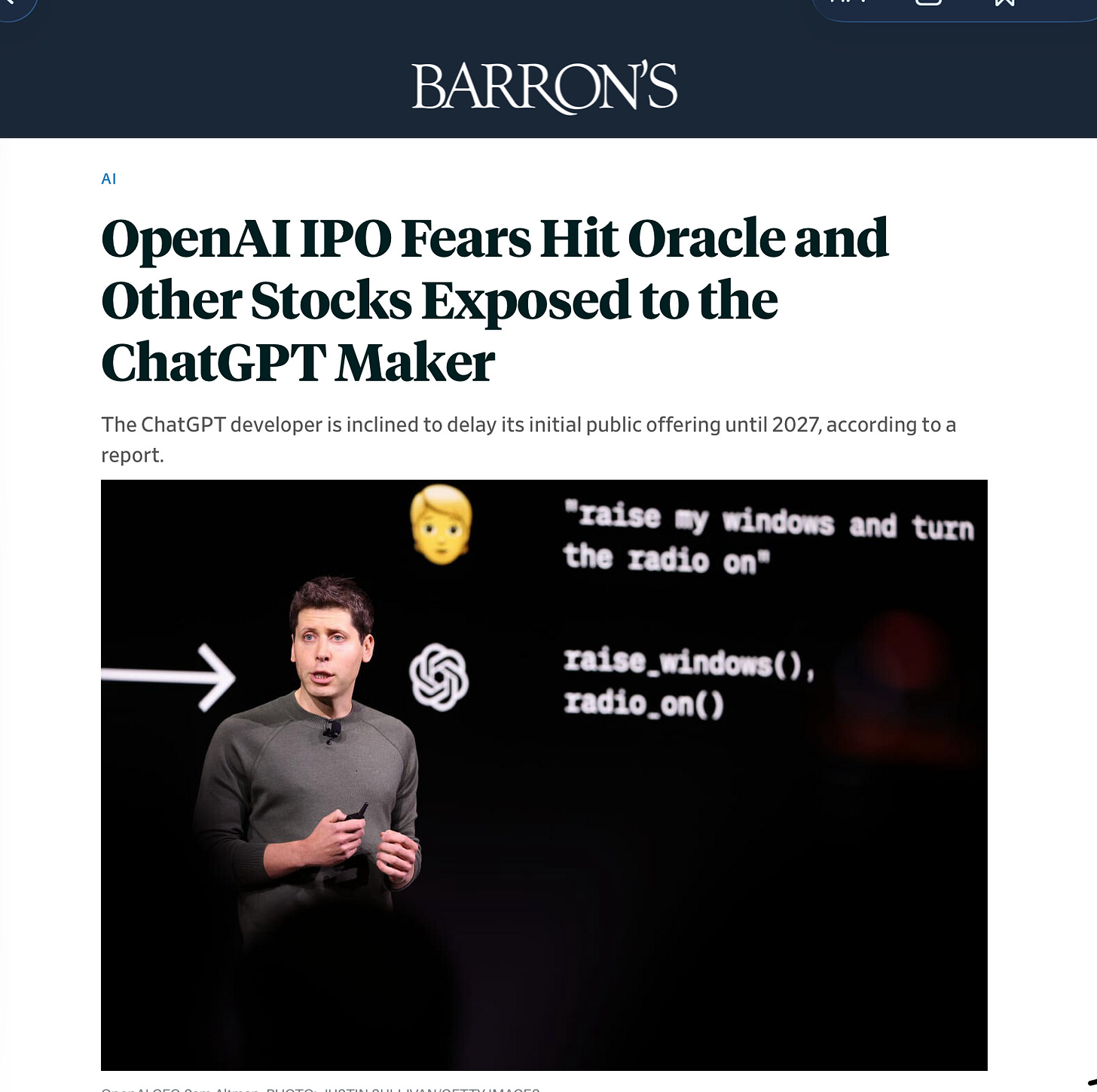
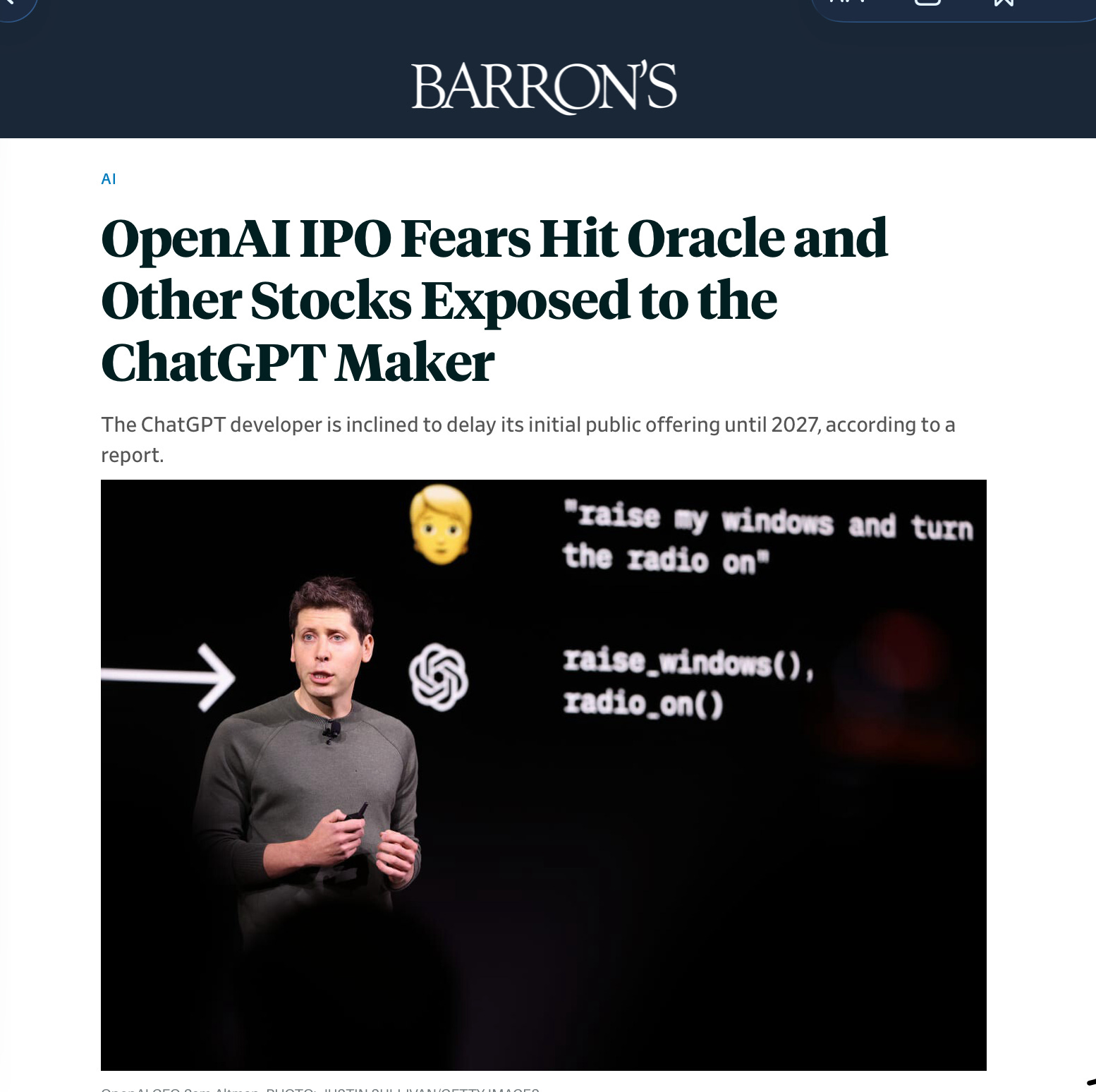
OpenAI is leaning towards delaying its IPO until next year:
 The New York Times@nytimesOpenAI is leaning toward holding off its IPO until next year, people involved in the company’s deliberations said, a delay that highlights the unclear paths of A.I. titans.nyti.msOpenAI Leans Toward Holding Up I.P.O. Until Next Year9:11 PM · Jun 25, 2026 · 199K Views42 Replies · 88 Reposts · 314 Likes
One rumor is that Altman was told he can’t get the valuation he wants:
 NIK@ns123abc🚨BREAKING: OPENAI IPO DELAYED Altman told everyone OpenAI is worth a TRILLION dollars His own advisors warned him that retail investors aren’t buying it… gave him 2 options: >wait until 2027 for $1T valuation >or lower valuation for 2026 IPO Altman: any valuation under $1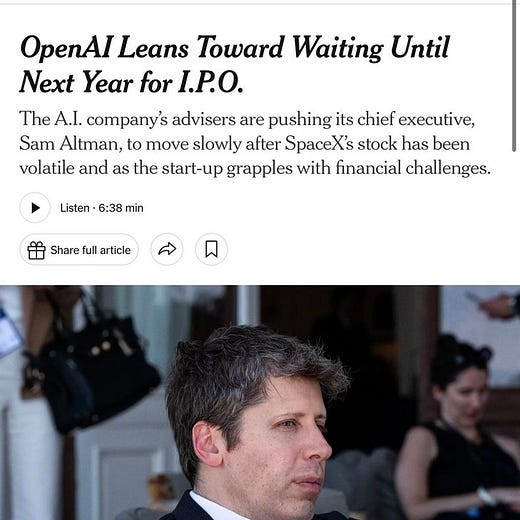
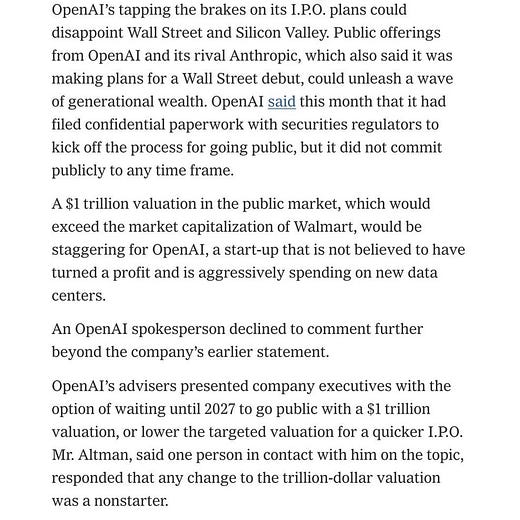 10:37 PM · Jun 25, 2026 · 187K Views88 Replies · 102 Reposts · 1.06K Likes
Another rumor is that Altman is worried that the SpaceX IPO isn’t taking off. Also, per the Times, “….OpenAI’s advisers, in conversations with the company over the past week, …caution that it may not find much enthusiasm from retail investors for its own shares, two of the people involved said”. Still others have wondered whether OpenAI’s financials are solid enough yet. However you slice it, the delay reflects a lack of confidence.
As I long predicted, troubles with OpenAI may hurt other companies that they do business with. We are perhaps already seeing evidence for that
SpaceX, increasingly pitched as an AI play, has lost steam (up slightly for the day, but down 11.74% for the week), and its bonds are doing badly, too:



Nvidia is down over 8% over the last month; Oracle is down about 22% over the last month, CoreWeave is down a bit over 4% for the month, Microsoft 10% over the last month. SoftBank down about 12%. Chip company Cerebras is down 32% over the last month. See yesterday’s essay on the Fizzle

US AI policy is in shambles, drawing widespread scorn:


• Medical AI bull Eric Topol just posted this:


and there is this from Nobel Laureate Jennifer Doudna


• Backlash against AI is getting really intense for many reasons, as discussed for example yesterday by Paul Krugman:

• Chinese models are gaining traction, fast.


As I have said before, over and over, LLMs are becoming a commodity.
None of this bodes well for the US AI industry.
§
AI bulls of course will disagree. As Noah Smith pointed out, drawing on an excellent new report from Azeem Azhar et al, revenue is clearly up
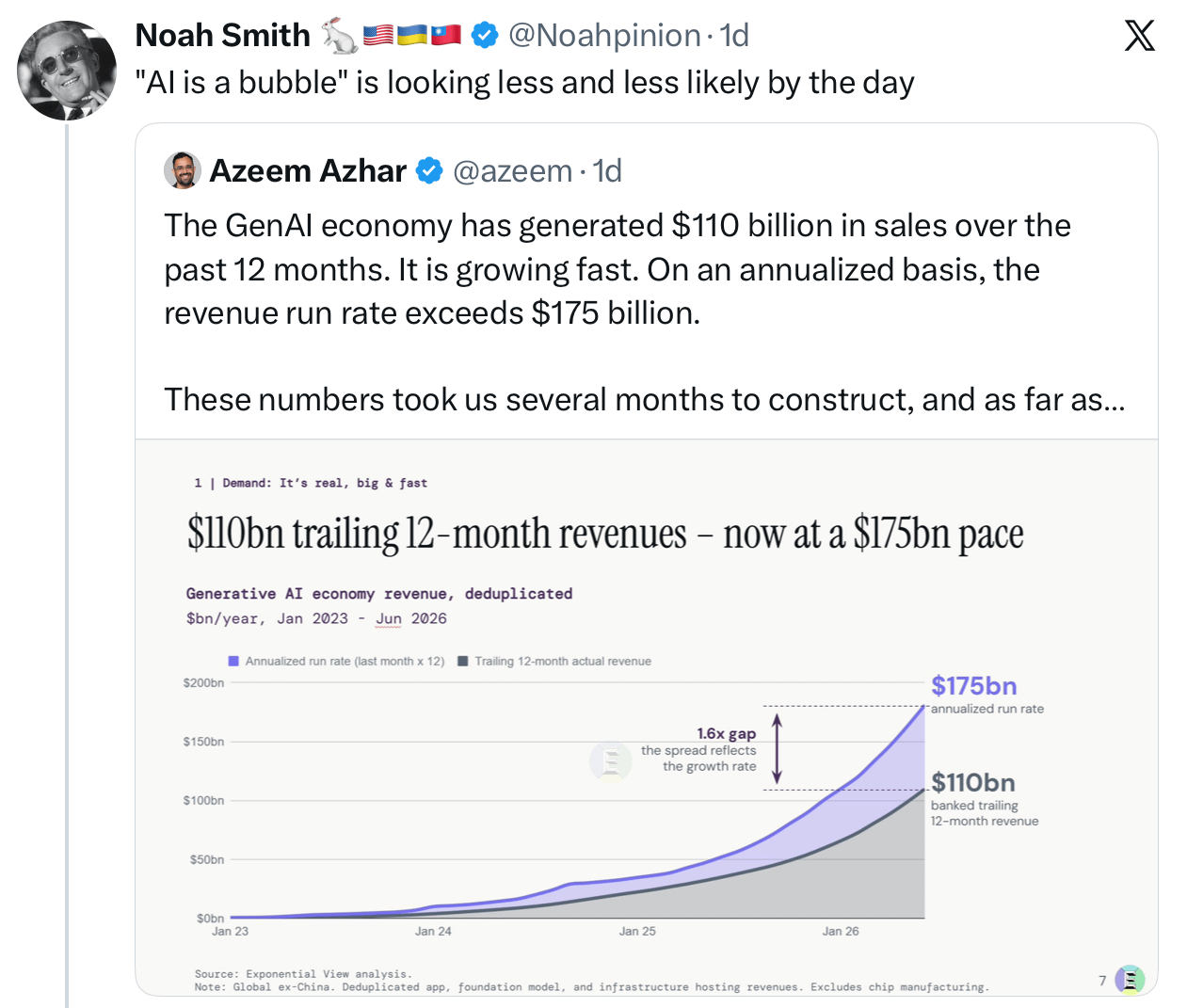
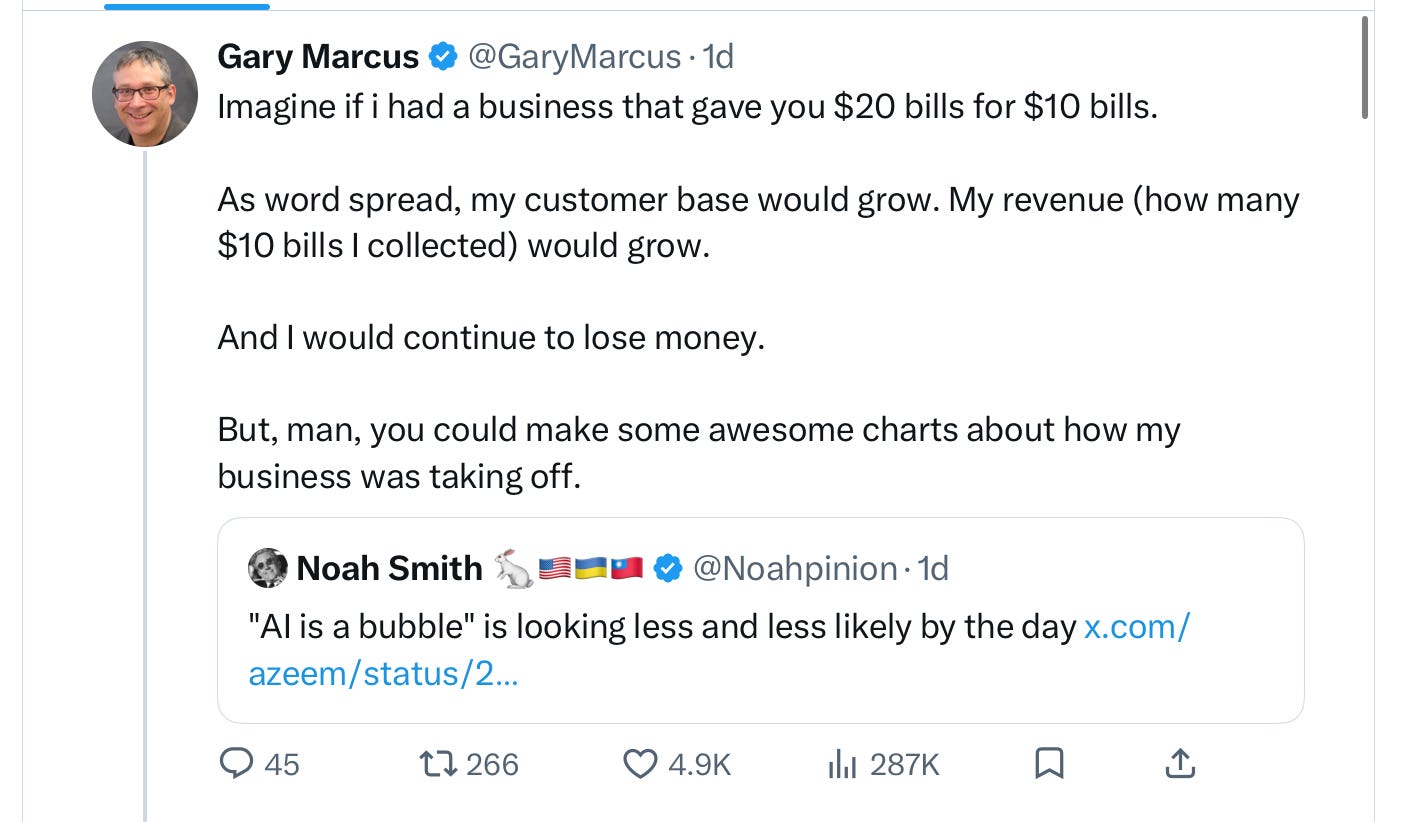
But Smith’s conclusion that there is no bubble doesn’t follow. The chart he shared shows that revenue is up, not that profitability is , nor that it can be sustained, as I noted on X:


Smith fired back, pointing to what might be Anthropic’s first profitable quarter.


But he left a lot out. In focusing on Anthropic’s not yet confirmed spring quarter Smith ignored the fact that the spring quarter — which he selected post hoc and which looks different from all others — was (a) during peak tokenmaxxing, (b) before recent Chinese advances, and (c) in a quarter in which SpaceX gave Anthropic a big one-time subsidy, quite possibly larger than the profit.
And, again, the WSJ prediction of a positive quarter that Smith pointed to was speculation; it’s not at all clear that it will actually come to pass, given all that happened since then. With the decline of tokenmaxxing, the rise of Chinese models, and the U.S. government pause on Fable, June was not as kind to Anthropic as April and May were. So we’ll see.
Ed Elson’s overall take on Anthropic’s profitability, just posted, was this:


Even Polymarket sees it now; the game has changed:

§
I tried to distill my basic argument yesterday in the FT. Here’s one part of it:
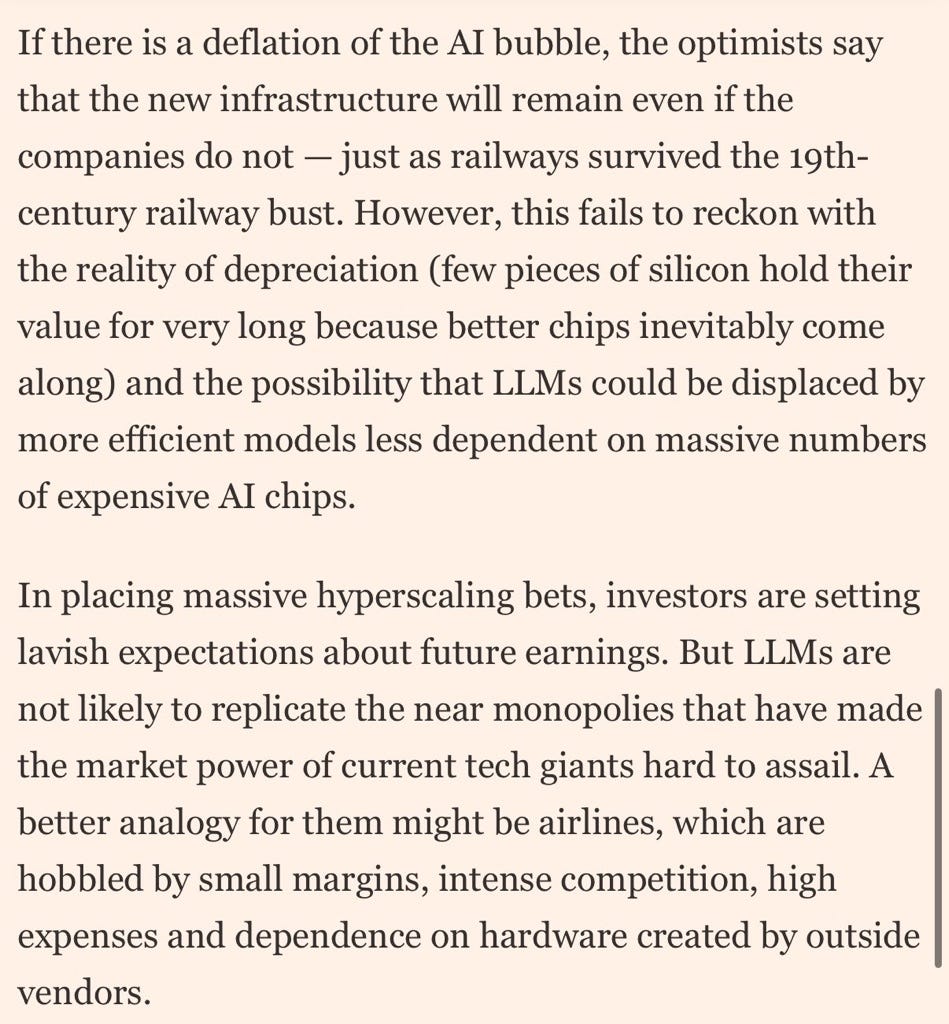
If the argument I laid out there is remotely correct, hyperscaling could prove to be among the biggest financial blunders in history.
P.S. An analogy worth considering:
P.P.S. Fun new interview:


Sharp, thanks for sharing this.
On OpenAI's IPO delay: This is good and bad simultaneously.
Good: their current IPO timeline is far too compressed and they're racing to do so much in a short period of time, it buys them time to try and improve financials - valuation, profitability, etc - before finally releasing their S-1.
Bad: they need the money now because of the cash they're burning and IPOs are the final frontier for a company with OpenAI’s valuation to do that, their financials weren't good + attracts more public scrutiny from investors (they can hide a little longer), SpaceX's IPO may have sucked the oxygen (liquidity) out of the markets for now, hence Google frontrunning them with the $85bn equity raise. Also Anthropic have better numbers + a non-zero chance of reaching profitability, even if it’s small.
Sarah Friar was ultimately right with wanting to float OpenAI in 2027, but she can’t walk back that “looking for a government backstop” comment back in Nov ‘25.